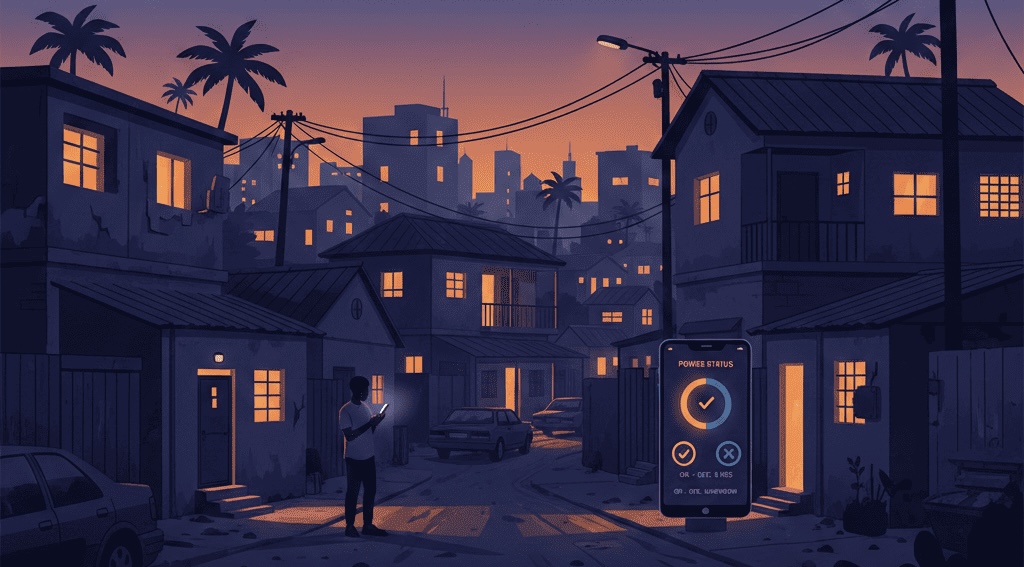
"Is there light?"
If you've lived in Nigeria for any amount of time, you've either asked this question or been asked it countless times. It's the text message you send before heading home. The first thing you ask when you call a friend. The question that determines whether you'll buy fuel for the generator or save that money for something else.
For decades, Nigerians have relied on guesswork, phone calls, and neighborhood WhatsApp groups to figure out the most basic thing: whether there's electricity in their area right now.
I got tired of the guesswork. So I built something to fix it.
This article explores how Nigerians have traditionally tracked power outages, why those methods fall short, and how real-time community data is changing the game for millions of people who just want to know one simple thing: is there light?
The Nigerian Power Reality
Let's be honest about where we are.
Despite recent progress, over 85 million Nigerians still lack access to electricity, the largest deficit of any country globally, according to the World Bank. The national grid frequently collapses. Distribution companies (DisCos) implement "load shedding" that follows no predictable pattern. And even when there's power at the transmission level, your specific street might be in darkness because of a fault somewhere along the line.
The result? Uncertainty. Constant, exhausting uncertainty.
You don't know if you should:
- Start that load of laundry
- Charge your devices now or wait
- Buy generator fuel today
- Plan that Zoom meeting from home
- Store food in the freezer or eat it quickly
Every decision involving electricity becomes a gamble.
How Nigerians Currently Track Power (And Why It Fails)
Method 1: The Phone Call
"Hello, Mama, is there light for house?"
This is the most common method. You call someone who's physically in the location you care about. It works, but only if:
- Someone is home
- They pick up
- Their phone is charged
- You're willing to disturb them
And you only get information about one location at a time.
Method 2: The WhatsApp Group
Many estates, streets, and communities have WhatsApp groups where residents share power updates.
"Light don come!"
"NEPA don take light o"
"Which zone get light now?"
This is better than phone calls because information spreads faster. But WhatsApp groups have problems:
- Information gets buried under unrelated chats
- Not everyone reports consistently
- No historical data (you can't see patterns)
- Limited to people in that specific group
- No way to compare across areas
Method 3: Listening for Generators
When the neighborhood suddenly goes quiet — generators switching off one by one — you know NEPA has brought light. When you hear generators roaring to life in a cascade, you know power just went out.
This works if you're already in the area. Not helpful when you're at work, wondering about home.
Method 4: The Assumption Method
"Light usually comes around 6pm in my area."
Some people try to identify patterns. Maybe your area gets power on certain days, or at certain times. But these patterns are inconsistent and change without notice. You might base your whole evening plan on an assumption that turns out to be wrong.
Method 5: Check the Freezer
The old "touch the frozen fish" test. If it's still solid, power hasn't been out long. If it's soft, you've got problems.
By the time you're using this method, you've already lost.
The Real Cost of Not Knowing
Power uncertainty isn't just an inconvenience. It costs Nigerians real money and real opportunities.
Generator fuel waste: You buy fuel "just in case" and end up not needing it. Or worse, you run the generator for hours not knowing that NEPA power was available.
Food spoilage: Without knowing how long power has been out, you can't make informed decisions about refrigerated food. Families lose thousands of naira to spoiled food every month.
Business disruption: Small business owners — the barber, the woman selling cold drinks, the cyber café — can't plan their operations without knowing power status.
Health risks: People who depend on powered medical equipment need to know outage status immediately, not hours later.
Productivity loss: Work-from-home professionals waste hours trying to figure out if they should stay home or find somewhere with reliable power.
Mental load: The constant uncertainty is exhausting. Always wondering, always planning for the worst, never being able to trust that the lights will stay on.
What Real-Time Tracking Looks Like
Imagine checking your phone and instantly seeing:
- Whether there's power in your area right now
- How long the current outage (or uptime) has lasted
- When power typically comes and goes in your neighborhood
- Power status in other areas you care about (your office, your parents' house, your shop)
No phone calls. No scrolling through WhatsApp. No guesswork.
This is what real-time power tracking provides. And it's powered by the simplest resource available: people like you reporting what they see.
The Community-Powered Approach
The insight that changed everything for me was this: millions of Nigerians already know the power status in their location at any given moment. The information exists—it's just not being collected and shared efficiently.
What if, instead of calling your mother to ask about power, you could see a live status reported by anyone in that area? What if thousands of Nigerians contributed one small piece of information—"light just came" or "light just went"—and everyone benefited from the collective knowledge?
This is community-powered tracking. It works because:
Everyone can contribute: You don't need special equipment. Just a phone and 5 seconds to report.
More reporters = more accuracy: When multiple people report from the same area, you can trust the information.
Patterns emerge: With enough data over time, you can see when power typically comes and goes — not based on assumption, but on real historical records.
It scales: One WhatsApp group covers one estate. A proper tracking system can cover every neighborhood in every city.
How It Actually Works
The process is simple:
1. Report when light comes: Takes 5 seconds. You're helping everyone who cares about your area.
2. Report when light goes: Same thing. Quick tap, done.
3. Check status anytime: Before you leave work, before you buy fuel, before you plan your evening.
4. See the history: Know that your area typically gets 4 hours of power in the evening? Now you can plan around it.
That's it. No complex setup. No subscription fees. Just a community of Nigerians helping each other navigate the power situation.
What Changes When You Have Real Data
For Individuals
- Plan your charging: Know when to charge devices so you're not caught with a dead phone
- Save on fuel: Only run the generator when you actually need to
- Reduce food waste: Make informed decisions about what to cook and what to preserve
- Work smarter: Schedule important calls and video meetings when power is available
For Families
- Coordinate better: Everyone knows the power situation at home without multiple phone calls
- Protect investment: Know when to check on freezers and refrigerators
- Keep kids informed: Children doing homework know if they should rush or take their time
For Businesses
- Serve customers better: Know when to expect power for your shop or office
- Reduce generator costs: The biggest expense for many small businesses
- Plan operations: Schedule power-intensive work for when electricity is available
- Compare locations: If you're choosing where to open a new branch, power reliability data matters
For Communities
- Hold DisCos accountable: When you have data on actual power supply, you have evidence
- Identify patterns: Some areas consistently get less power—data proves it
- Advocate for change: Real numbers support real advocacy
Beyond Just Status: Understanding Patterns
Raw status ("light dey" or "light no dey") is useful. But patterns are powerful.
When you track power over weeks, you start seeing things like:
- Your area averages 6 hours of power per day, but it's distributed unpredictably
- Power is more likely in the morning (6am-10am) and evening (6pm-10pm)
- Weekends tend to have more stable power than weekdays
- The last week of the month often has less power (possibly related to billing cycles)
These patterns help you plan. Not with 100% certainty—this is Nigeria—but with better odds than pure guessing.
The Bigger Picture
Every time someone reports power status, they're contributing to something larger than their own convenience. They're helping build a picture of electricity distribution across Nigeria.
Where is power most reliable? Which DisCos are serving their customers best? Which neighborhoods are consistently underserved? How does power distribution change over time?
This data matters. It can inform policy. It can support advocacy. It can help Nigerians make better decisions about where to live, where to do business, and what to demand from their electricity providers.
Getting Started with Real-Time Tracking
If you're tired of the guesswork, here's how to start:
1. Download a tracking app: LightDey is built specifically for this purpose—by Nigerians, for Nigerians.
2. Add your address: The location you want to track—home, office, anywhere you care about.
3. Report when power changes: It takes seconds and helps everyone.
4. Check before you decide: Going home? Buying fuel? Planning an event? Check the real-time status first.
5. Invite your neighbors: The more people reporting in your area, the more reliable the information.
Common Questions
"What if someone reports wrong information?"
When multiple people report from the same area, the truth emerges. One wrong report gets corrected by several right ones. The system is built to handle this.
"Do I have to report every time?"
No. Report when you can. Even occasional reports helps, but the more the better. And you benefit from everyone else's reports whether you contribute or not (though contributing helps everyone).
"What about areas with few users?"
Every area starts somewhere. As more people join, coverage expands. You might be the first regular reporter in your area—which makes you incredibly valuable to your neighbors.
"Does this use a lot of data?"
Minimal. Reporting uses less data than sending a WhatsApp message. Checking status is even lighter.
"Is this free?"
Yes. The core functionality — reporting and checking power status — is completely free.
The Future of Power Tracking in Nigeria
We're at the beginning of something important. As more Nigerians adopt real-time tracking:
- Coverage will expand to every neighborhood in every city
- Predictions will improve as we gather more historical data
- DisCos will have incentive to improve when their performance is publicly tracked
- New tools will emerge that build on this data—smart home integration, business analytics, community comparisons
The days of guessing about power are ending. Not because the grid is getting better (though we hope it will), but because Nigerians are taking information into their own hands.
Conclusion
For too long, the question "Is there light?" has been answered by guesswork, phone calls, and assumptions. Millions of Nigerians have made important decisions—financial, professional, personal—based on incomplete information about something as basic as electricity.
Real-time power tracking changes that. It takes the knowledge that already exists in millions of minds and makes it accessible to everyone. It turns a nation of people individually struggling with power uncertainty into a community collectively solving the information problem.
The power grid may not change overnight. But how we deal with it can change today.
Next time someone asks you, "Is there light?", you won't need to guess. You'll know.
Elisha Ukpong
Author at LightDey
Elisha Ukpong is a contributor at LightDey, passionate about empowering communities through technology and helping Nigerians optimize their energy usage.